
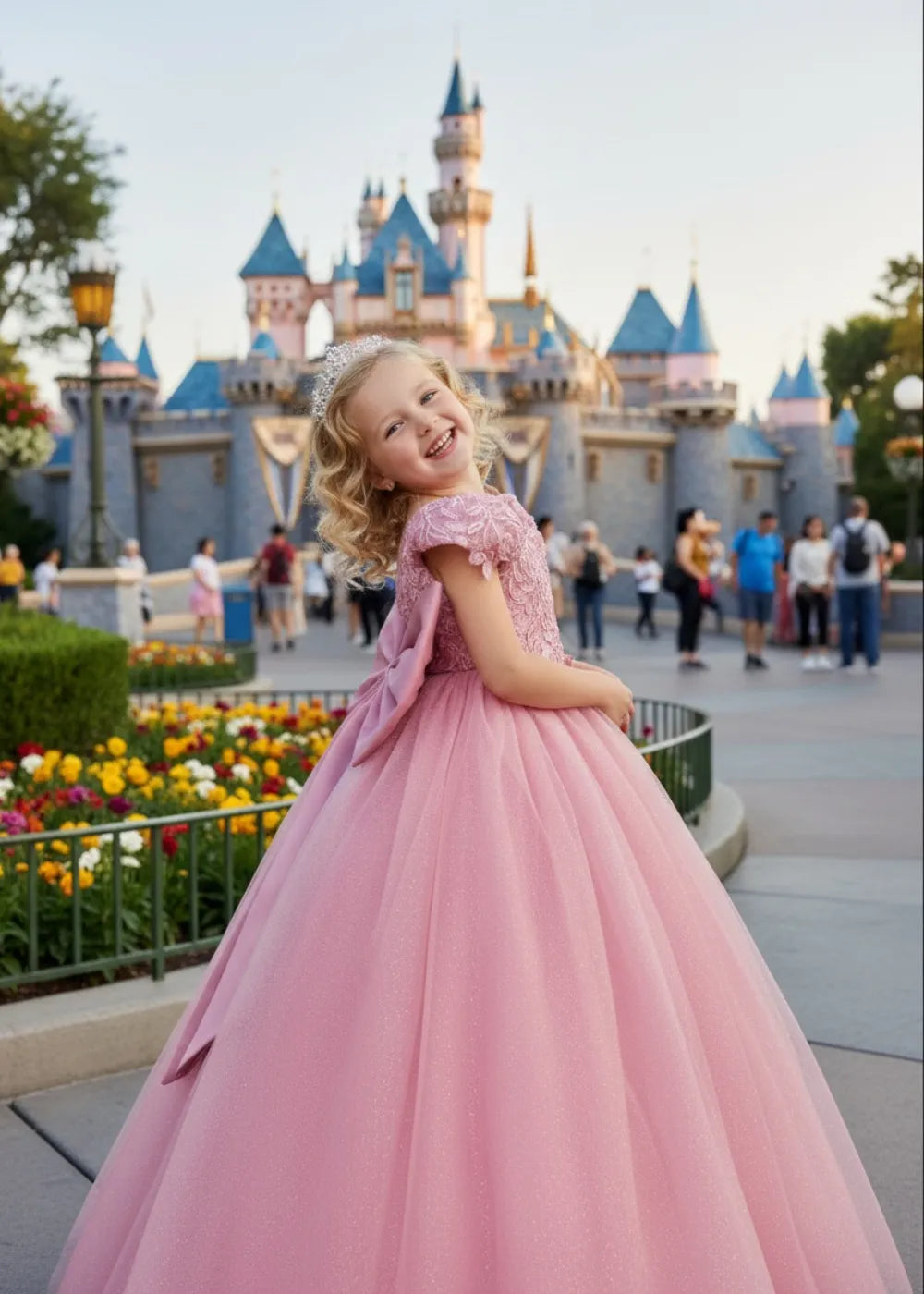

According to The Knot's flower-girl attire guidance, shoppers should separate three decisions they often collapse into one: the wedding's formality, the child's age, and the dress length she can manage.
I compared that guidance with formalwear fabric advice, bridal-party color guidance, live Fynony collections, and recurring questions from parents choosing dresses for toddlers and younger attendants.
The result is a more reliable rule than “pick velvet” or “add long sleeves”: choose the flower girl's formalwear role first, then judge the fabric construction, length, color relationship, and fit.
A dress gets the green light when it belongs beside the bridal party, looks right in the venue, and lets the child walk, sit, bend, and raise her arms without fighting the garment.
The lower-regret default is to reject any style that looks seasonal in a product photograph but misses the wedding's level of formality or the child's practical needs.
What You'll Learn
You will also see four common wedding scenarios with a direct verdict for each one.
I compared the scenarios by changing one decision at a time, because a ballroom, a hotel, a toddler's role, and a specific bridesmaid palette create different priorities even in the same season.
This approach keeps the article centered on girls' formalwear rather than turning “winter” into a substitute for dress selection.
Quick Answer
Choose the dress in five passes: formality, construction, manageable length, bridal-party coordination, and full-outfit fit.
A winter detail such as sleeves, velvet texture, a cape, or a cardigan should refine those five decisions rather than replace them.
Start with the live flower girl dresses collection only after the venue and dress code are clear, because a narrower brief makes comparison faster and reduces impulse choices.
✅ The simplest correct order is wedding first, dress second, winter finishing third.
The Five-Step Decision Framework
This five-step sequence is the article's decision framework, and each step can reject a dress before the next one adds detail.
Step 1 removes styles that miss the venue even if their color or decoration is attractive.
Step 2 removes dresses whose fabric name sounds right but whose actual construction does not support the intended silhouette.
Step 3 removes lengths that fit the size chart but interfere with the child's role.
Step 4 removes forced color matches and replaces them with a deliberate relationship to the wider wedding palette.
Step 5 removes any finalist that changes the child's stride, reach, posture, or willingness to wear the full outfit.
Use sleeves and removable pieces only after a dress survives all five steps, because finishing details should not reopen a failed decision.
✅ If a dress fails one step, reject it or fix that specific condition instead of hiding the problem beneath another accessory.
Start With the Wedding's Formality and Venue

The venue tells you how much visual presence the flower girl needs before you compare individual fabrics.
A formal ballroom can support a fuller skirt, richer texture, and more deliberate shine, while a smaller daytime ceremony may look better with lighter volume and fewer competing details.
Expert guidance from The Knot links material choice to venue, dress code, and overall formality, which is more useful than treating one material as the universal winter answer.
I compared the same ivory dress concept across a structured satin bodice, a velvet bodice, and a soft tulle silhouette, and each version signals a different degree and kind of formality even before color changes.
The flower girl should look connected to the wedding party without appearing as though an adult bridesmaid dress was reduced to a child's size.
That distinction affects neckline, waist placement, skirt volume, embellishment scale, and hem control as much as it affects color.
For a formal processional, ask whether the dress creates a clean line while the child walks rather than only when she stands still.
For a hotel reception, ask whether the texture and sheen still make sense beside the table setting, bridal-party fabrics, and the bride's gown.
For a less formal ceremony, remove details before you remove polish, because a clean silhouette can look intentional without becoming ornate.
Watch: https://www.youtube.com/watch?v=Ii_JthTYGQ0
✅ Write down the dress code, venue type, bridesmaid fabric, and preferred flower-girl length before opening product pages.
Choose the Dress Construction, Not Just a Winter Fabric Name

“Velvet dress” and “tulle dress” describe visible materials, not the whole garment.
Two dresses with the same fabric label can feel and behave differently because their lining, seam placement, layer count, waistband, closure, and embellishment backing are different.
A smooth lining can separate the child from decorative texture, while a short lining under a long skirt can change both opacity and how layers move around her legs.
A well-placed zip can make dressing straightforward, while a short or stiff closure may require more pulling over the child's head and shoulders.
I compared construction details before surface decoration because the hidden side of the dress determines whether the formal look survives more than a posed photograph.
Check whether lace edges or appliqué backing reach the neckline and armholes, where movement creates repeated contact.
Check whether the waist seam sits at the intended point when the child sits, because a comfortable standing fit can become pressure at a chair.
Check whether the outer skirt and lining move together, because a long decorative layer can catch even when the shorter lining seems manageable.
The velvet dresses collection is useful when rich texture fits the wedding, but every individual style still needs the same construction review.
✅ Buy the complete garment you inspected, not the promise implied by one fabric word.
Match Detail Scale to the Child
How to Pick a Flower Girl Dress | Perfect Wedding
Scale separates polished flower-girl styling from an adult formalwear idea reduced without adjustment.
A child-size bodice has less visual space, so one large motif can carry the same weight as several details on an adult gown.
Choose a focal point, then keep the neckline, waist, skirt, shoes, and hair accessories quieter around it.
Inspect how decoration is attached and backed because visual scale and physical comfort meet at the same seams.
✅ Keep the detail when it supports the silhouette from normal viewing distance and remove it when the eye sees decoration before the flower girl.
Velvet, Satin, Tulle, and Lace: Where Each Fits
Velvet contributes visual depth, which can make burgundy, navy, emerald, black, ivory, and other formal shades look especially rich.
Satin contributes polish and reflected light, so color may appear lighter or brighter than it does in a matte fabric.
Tulle contributes volume and movement, but the important buying details are the softness, layer count, lining, and hem control rather than the word “tulle.”
Lace contributes bridal texture, but scale matters because oversized motifs or heavily decorated edges can overwhelm a very small bodice.
The existing tulle flower girl dress guide explains how to judge layers and net that product photographs may not reveal.
A useful winter flower girl dress may combine these materials, such as a satin bodice with a tulle skirt or velvet accents over a lined base.
Judge the combination by hierarchy: one material should establish the main formal impression while the others support it.
A velvet bow can add seasonal depth without making the entire garment velvet, and a lace overlay can connect to the bride without copying the bridal gown.
Avoid ranking these fabrics from “best” to “worst” without a venue, silhouette, and child in mind.
✅ Choose the material for the formal effect it creates, then verify the construction that makes that effect wearable.
Read a Formal Dress Product Page in the Right Order
Begin with measurements rather than the styled image, because an unsuitable size cannot be repaired by a perfect color.
Move to the full silhouette before zooming into decoration, because length, waist placement, and skirt volume control the child's overall proportion.
Read the material description as a list of components rather than one headline fabric, especially when the dress combines satin, velvet, lace, and tulle.
Use back and detail photographs to identify the closure, exposed seams, applied decoration, and places where an alteration may interrupt a motif.
Treat color names as search labels until a physical swatch or reliable comparison confirms the undertone and sheen.
A user review can alert you to a question worth checking, but the garment's listed measurements and the child's fitting should control the decision.
Save screenshots or notes for the three strongest candidates using the same order so visual excitement does not change the standard from one dress to another.
✅ Keep a product on the shortlist only when its measurements, silhouette, construction, detail views, and color evidence all support the same wedding brief.
Choose Length and Silhouette by the Flower Girl's Age
Age does not choose the size, because chest, waist, shoulder, and length measurements do that job.
Age and independence do help choose how much skirt the child can manage without an adult adjusting it throughout the ceremony.
The Knot's flower-girl attire guidance notes that younger children often do better with a manageable shorter hem, while longer dresses can suit older flower girls who can control them.
Tea length is a valuable middle option because it can look ceremonial while keeping shoes and lower-leg movement visible.
A floor-length dress may suit a formal ballroom, but it earns that role only when the child can walk, turn, sit, and step up without lifting the skirt.
A very full knee-length skirt can be harder to manage than a narrow ankle-length skirt, so compare silhouette and length together.
The toddler flower girl dresses collection can narrow the scale of the search, but the listed garment measurements should still be compared with the child's current measurements.
I compared hem recommendations by looking at the longest outer layer, not just the lining, because tulle and lace overlays determine what can reach the shoes.
Shoes belong in the fitting session because heel height, sole grip, toe shape, and straps change how confidently the child moves.
✅ Choose the most formal length she can manage independently, not the longest length the wedding could theoretically support.
Turn Measurements Into a Three-Dress Shortlist
Take current measurements according to the measuring method used by the specific size chart, because brands may define the same field differently.
Record the date and the planned shoe so a later fitting can explain whether the child, shoe, or garment changed.
Do not size up automatically to gain length, since a larger bodice can move the armholes, neckline, waist, and closure away from their intended positions.
Do not size down automatically to shorten a hem, since chest and waist comfort still have to pass.
Shortlist three dresses at most after measurement screening, then compare their longest layers, skirt volume, lining, and alteration options.
A local alteration may refine a suitable dress, but the original construction should determine whether changing the hem, waist, sleeve, or embellishment is realistic.
If the wedding is still months away, plan another measurement check rather than adding an unsupported amount of growth room.
✅ Use measurements to choose the candidate size and a movement rehearsal to approve the final length.
Coordinate Color With the Bridal Party

The Knot's flower-girl color guidance allows the child to echo the bride, bridesmaids, or wider wedding palette rather than matching one person exactly.
That source supports coordination by relationship, which is the practical rule used throughout this section.
Research from David's Bridal similarly describes bridal-party coordination through shared colors, fabrics, or design elements, which gives families more than one path to a cohesive result.
Community discussions on Reddit repeatedly show the practical problem: exact bridesmaid shades can be difficult to reproduce in flower-girl sizing and a different fabric.
The first low-regret method is a related color family, such as a softer dusty blue beside deeper blue bridesmaids or a lighter sage beside emerald.
The second is an ivory or white flower girl dress with one controlled accent pulled from the bridesmaid palette.
The third is a shared fabric mood, such as satin sheen or velvet depth, while keeping the flower girl's silhouette and length appropriate for her age.
Order physical swatches whenever exact coordination matters because screens, studio lighting, dye lots, and fabric sheen can change how a named color appears.
Place the swatches beside the bride's gown and key flowers as well as the bridesmaid dress, since the flower girl appears within the whole visual group.
Watch: https://www.youtube.com/watch?v=mmlhOgumVF4
For a deeper color-selection process, use the existing flower girl dress colors guide after choosing the coordination method here.
✅ Match the relationship among colors, not merely the words printed beside them.
Check Lining, Seams, Closure, and Movement

A complete fit test should use the underwear, hosiery, shoes, sash, and hair accessories planned for the wedding.
The test needs movement because a dress can look correctly sized from the front while restricting the shoulders, pressing at the waist, or shifting around the shoes.
Start at the neckline and armholes, then move down through the bodice, waist, lining, longest skirt layer, and shoes.
Feel the inside seams and embellishment backing with a hand before asking the child how the garment feels, because vague discomfort can be difficult for a young child to locate.
Watch what she does without prompting, since repeated tugging at a sleeve, neckline, waistband, or skirt often identifies a problem faster than a posed question.
The movement sequence should include walking at aisle pace, sitting for several minutes, bending to reach a dropped item, turning, and raising both arms.
A formal dress does not pass because the child can tolerate it briefly; it passes when she can do her flower-girl job without constant adjustment.
I compared the fit checks from the child's point of view rather than the camera's, because confidence during the processional depends on predictable movement.
Complete the test early enough to exchange the dress or make a planned alteration rather than improvising on the wedding day.
✅ Keep the dress only when the child, closure, lining, hem, and shoes all pass as one outfit.
Add Sleeves or a Removable Layer Only After the Dress Is Right
Choosing Flower Girl Dresses for the Wedding
Sleeves belong late in the decision sequence because they are one component of the silhouette rather than proof that a dress suits a winter wedding.
A long-sleeve design can look elegant in lace, satin, velvet, or tulle, but shoulder movement and cuff comfort still need to pass.
The existing long-sleeve flower girl dresses guide explains how to choose sleeves for a specific reason instead of treating the season as the only reason.
A removable cape or cardigan can support the finished outfit when its color, length, closure, and texture agree with the dress.
Try the layer over the actual sleeve and bodice because bulk at the armhole or neckline can change the fit.
Remove it during the rehearsal to confirm that hair, sash, buttons, bows, and delicate surface details stay undisturbed.
Keep accessories visually subordinate to the dress unless a cape or bow is intentionally the main styling detail.
Avoid adding several seasonal pieces simply because each looks appealing on its own, since gloves, cape, tights, sash, hair decoration, and a detailed dress can compete.
✅ Finalize sleeves and removable pieces only after formality, construction, length, color, and movement are settled.
Scenario 1: Formal Church or Ballroom Wedding
A formal church or ballroom asks the flower girl's dress to hold its place beside long gowns, ceremonial architecture, and a deliberate processional.
Start with proportion rather than ornament, because a clean structured shape can read more formal than a lightly made dress covered in decoration.
Satin can create a polished line, velvet can add rich depth, lace can reference bridal detail, and tulle can create controlled volume.
The choice among them depends on the bride's gown, bridesmaid fabric, venue scale, and the child's ability to manage the silhouette.
A tea-length hem can still look formal when the bodice, fabric, and finish are polished, especially for a younger flower girl.
A floor-length hem should be reserved for a child who has rehearsed the processional and can keep both hands free for petals or a basket.
A style such as a satin flower girl dress with a pearl tulle cape is relevant only when its cape detail, satin finish, measurements, and overall silhouette match the event brief.
Do not add a tiara, oversized bow, embellished shoes, and a statement cape merely to make the outfit feel more formal.
Verdict: Choose a polished, proportionate dress with controlled volume and the most formal hem the child can manage independently, then use one restrained detail to connect her to the bridal party.
Scenario 2: Elegant Hotel Wedding
An elegant hotel gives families more flexibility than a strict black-tie ballroom while still rewarding polished construction.
Satin, velvet, lace, and tulle can all work because the deciding factor is how the material is cut, lined, combined, and coordinated.
A smooth satin A-line may connect naturally with satin bridesmaid dresses, while a velvet bodice may introduce depth beside a matte bridal-party palette.
Controlled tulle can give the flower girl movement without turning the skirt into the largest shape in the wedding party.
A hotel interior often combines several textures in the décor, so the dress needs a clear hierarchy rather than every possible detail.
Choose one primary feature, such as a bow, cape, lace bodice, pearl accent, or rich fabric, and let smaller choices support it.
If bridesmaids wear a strong color, the flower girl can use a lighter related shade or an ivory base with a shared sash instead of chasing an exact match.
Rehearse sitting as carefully as walking because the child may spend more time at a ceremony chair or reception table than in the aisle.
Verdict: Choose the fabric and silhouette that best echo the hotel's polish and the bridal party's visual mood, then limit the outfit to one dominant detail and one clear color relationship.
Scenario 3: Younger or Toddler Flower Girl
A toddler's outfit should look formal without depending on adult-level skirt control or patience.
Begin with the longest outer layer because lace or tulle can reach the shoes even when the lining is shorter.
Knee and tea lengths are strong starting points when the child is new to formal dresses, stairs, or processional pacing.
Use actual measurements for size, but use the child's independence to decide how much length, volume, and decoration she can manage.
A raised waist can create an age-appropriate proportion, although the seam still needs to sit comfortably when she bends and sits.
Avoid loose shoulder straps, trailing sashes, rigid embellishment near the arms, and shoes that alter her normal stride.
Parents in wedding-planning communities often ask where to find a formal toddler dress that is not too long, which confirms that manageability is a central buying decision rather than a minor alteration issue.
A short rehearsal should include carrying the exact basket or flowers, since both hands may be occupied during the aisle walk.
Let the child spend several minutes in the complete outfit, because immediate approval does not reveal how a waistband, sleeve edge, or shoe feels over time.
Verdict: Choose a knee- or tea-length dress with controlled volume, complete lining, easy closure, and stable shoes unless the child has already demonstrated that she can manage a longer formal silhouette.
Scenario 4: Matching the Flower Girl to Bridesmaids
Matching does not have to mean identical color, fabric, neckline, sleeve, and skirt.
Select one or two signals that a viewer can read immediately, such as a related color and satin sash or an ivory dress and flowers in the bridesmaid shade.
If the bridesmaid color is burgundy, navy, or emerald, a lighter related flower-girl shade can keep the palette cohesive without creating a miniature adult gown.
If the bride wants the flower girl in white or ivory, repeat the party color in one removable or decorative accent.
If exact color matters, compare physical swatches under more than one light because satin, velvet, tulle, and chiffon reflect the same hue differently.
Use the bride's gown as a second reference so the flower girl's ivory, white, champagne, or lace does not create an accidental undertone clash.
Avoid matching by product color name alone because retailers may use the same name for visibly different shades.
The final group should look related at a glance while each dress remains appropriate to the wearer's age and role.
Verdict: Coordinate through a related color family, an ivory or white base with one shared accent, or a common fabric mood, and require an exact match only when physical swatches prove it.
Common Mistakes With Winter Flower Girl Dresses
The shared pattern behind these mistakes is using a shortcut where the decision needs a relationship.
“Winter” has to relate to the wedding's formality, a fabric has to relate to its construction, a hem has to relate to the child's control, and a color has to relate to the whole bridal party.
A long sleeve does not rescue a dress that is too casual for the venue, just as velvet does not rescue a bodice with uncomfortable seams.
An exact color match does not improve the group if the flower girl's silhouette looks too mature or the fabric reflects the shade differently.
A beautiful long skirt does not become practical because the size chart says it fits at the chest and waist.
The most expensive mistake is discovering on the wedding day that the child cannot sit, reach, walk, or use the closure comfortably.
The most visible mistake is adding several disconnected details in an attempt to make the outfit look special.
Instead, keep the selection order stable and allow each later decision to refine the earlier one.
✅ Formality controls construction, construction supports silhouette, silhouette controls manageable length, color connects the party, and the fit test approves the final outfit.
Quick Decision Checklist
Take the dress code, venue, bridesmaid swatch, child's current measurements, preferred maximum hem, and shoe choice into the final comparison.
Browse special occasion dresses only after those details are written down, so the collection becomes a filtered decision space rather than an inspiration feed.
Compare no more than three finalists side by side using the same five headings: formality, construction, manageable length, coordination, and fit.
Reject a finalist as soon as it fails a non-negotiable condition instead of compensating with more accessories or alterations that change the original plan.
Keep photographs of the inside lining, closure, waist seam, longest skirt layer, and physical color swatches with the measurements.
Schedule the full-outfit rehearsal while an exchange or alteration is still possible.
✅ Choose the dress that makes the flower girl's role look natural, polished, and comfortable within the wedding rather than the dress that collects the most winter details.

Shop a Velvet Tulle Flower Girl Dress
Shop Now →


